
Open-source performance reviews
Performance reviews your people can trust.
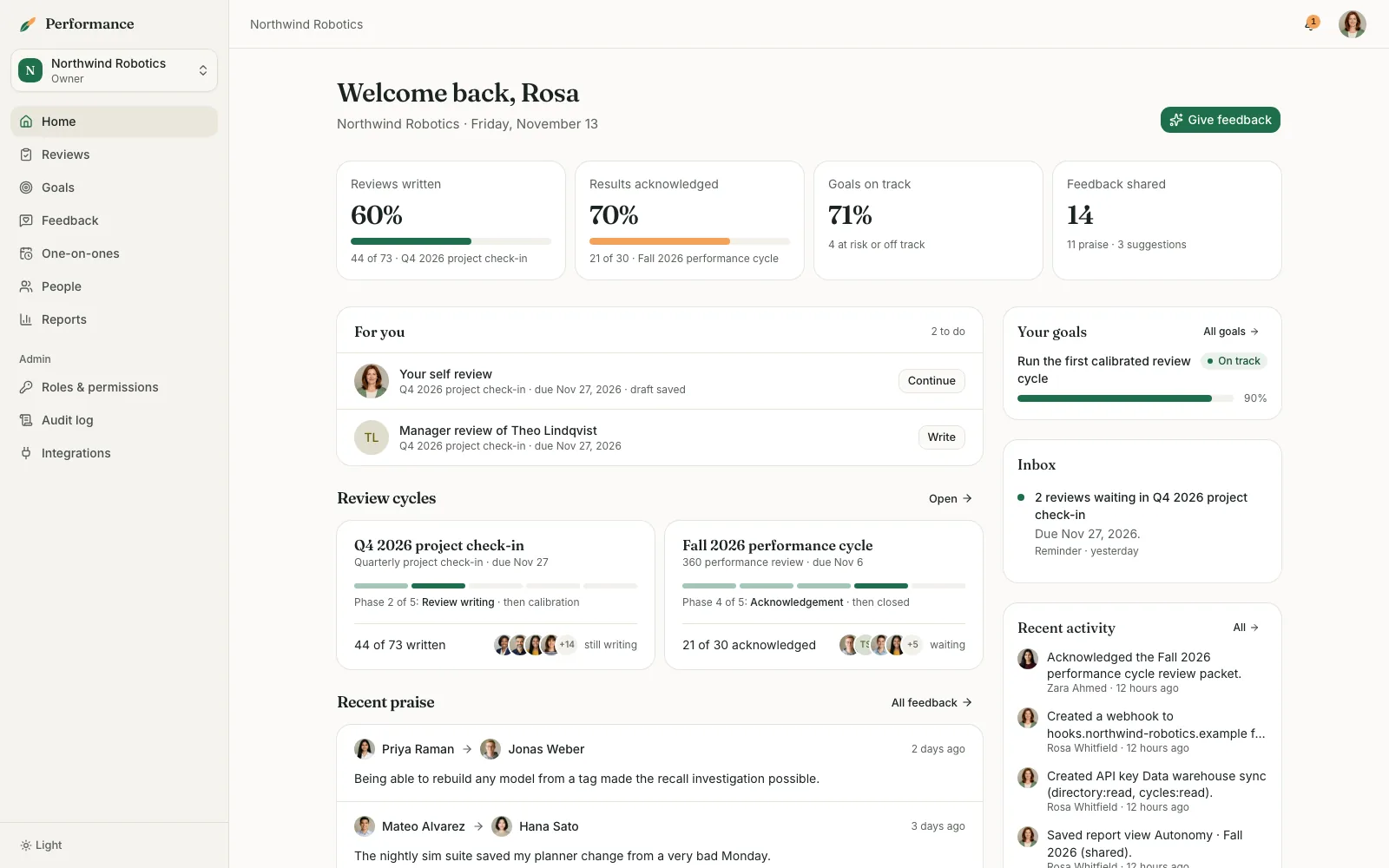
Run self, manager, peer and upward reviews with phases you preview before they happen and can undo after. Permissions you can inspect, feedback that stays fair, and every review, goal and 1:1 in one export.
Free and open source. No per-seat price, no minimum contract.
Why it feels different
A review cycle that's fair to everyone in it
The hard parts of performance reviews are trust and timing. Performance makes both visible.
Phases you can preview and undo
Every phase change shows its effects, blockers and warnings first, moves one step at a time, and can be reversed without losing anything anyone wrote.
Permissions you can inspect
Sixteen plain-language permissions, a permission simulator and View as role, so you see what a role can do before anyone has it.
Fair by design
Peer and upward feedback is anonymised — and withheld, not averaged, when too few people responded. Answers and feedback text never enter the audit log.
Self, manager, peer and upward
Peer nominations with approvals, deadlines, reminders and escalations in an in-app inbox, calibration, review packets and acknowledgement.
Goals, feedback and 1:1s
Goals with check-ins, praise and constructive feedback with clear visibility, shared 1:1 agendas, and a timeline that only shows what each viewer may see.
Reports you can save
Completion by direction and team, acknowledgement rates, goal health and the rating distribution, with private or shared saved views.
Built to protect people
Withheld, not averaged
Averaging two answers can still identify who wrote them. When fewer people respond than the cycle's minimum, Performance withholds those responses entirely — and the packet says how many came in and how many were needed.
Review packet · Fall 2026
Ana López
- Manager reviewPriya Shah, Engineering ManagerAttributed
- Self reviewAna LópezAttributed
- Peer 1 · Peer 2 · Peer 3Three teammatesAnonymised
- Upward feedback2 of 3 responses receivedWithheld
Calibration notes are never part of a packet.
How a cycle runs
From org chart to acknowledged review
Every step is previewed before it happens, and every privileged action lands in the audit log.
Import your people
Upload your org chart as a CSV and see every row before anything is written. Nobody gets admin rights from a spreadsheet.
Build a template
Versioned review templates with the questions and rating scales you choose.
Preview, then launch
See exactly what launching will do — who writes which review, and what's blocking — before you confirm.
Nominate and write
Employees nominate peers and managers approve. Reviews save as people write, with deadlines that show who is on track.
Calibrate and release
Calibrate ratings with private notes, then release packets with peer and upward feedback anonymised.
Acknowledge and keep
Employees acknowledge with a comment, a packet can be reopened with a reason, and the workspace exports as one versioned file.
Open source
Your review history leaves with you
Performance is free and open source under the AGPL-3.0. There's no per-seat price and no minimum contract, the code is public, and your data comes out in one versioned file.
One versioned export
Every review, goal, feedback item, 1:1 and audit event in one file, each part with its own schema, version and checksum.
A read API and signed webhooks
Scoped, revocable API keys for the directory, cycles and public goals, and HMAC-signed webhooks with an honest delivery log.
An append-only audit log
Every privileged action is recorded. Review answers, feedback text and ratings never are.
Isolated workspaces
Every read and write is scoped to your organisation and re-checked on the server.
FAQ
Good questions to ask
Run your next review cycle here
Create a workspace, import your org chart and preview your first cycle before you launch it.
Start your workspace